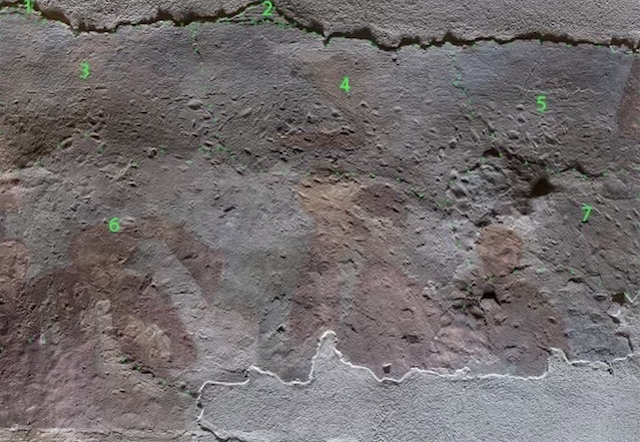
The research focuses on the frescoes of the Sapieha Palace, aiming to determine their technological execution, condition, and ensure proper preservation. For the first time in Lithuania, advanced non-invasive methods such as 3D imaging technologies, LIDAR scanning, infrared reflectography (IRR), and UV fluorescence were applied. These techniques enabled the precise identification of fresco giornata boundaries, verified against a map created by restorer Domas Noreika. The study emphasizes the importance of documentation in the conservation-restoration process, in line with the ICOMOS Charter principles. The results demonstrate that advanced technologies significantly expand the possibilities for analyzing, documenting, and restoring Michelangelo Palloni’s frescoes in Lithuania.